Editor-only node. Runs only in Mesh Morpher Graph inside the Unreal Editor, because it reads or writes Unreal Engine assets. Not available in the standalone Mesh Morpher Studio app.
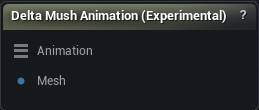
The Delta Mush Animation (Experimental) node
When to use it
Editor only. Runs Delta Mush on every frame of an animation and bakes the corrections into morph targets driven by that animation, so the skinning fix ships with the asset instead of costing a deformer at runtime.
Posing reads bone keys straight off the Animation pin, so a keyframe-only take with no live sequence behind it - a pure FBX import, or one edited past its source asset by Pose Animation Sequence - poses correctly. The baked morph targets still need a live asset to land on: with none, Apply computes the correction and then tells you there is nowhere to save it, rather than discarding the work silently.
How to use it
- 1
Connect a rest-pose mesh and an Animation input (from a Load Animation node)
- 2
Configure Delta Mush settings
- 3
Click "Apply" to process the animation and create corrective morph targets
Pins
| Pin | Type | Description |
|---|---|---|
Animation |
Animation | The animation to correct. It has to come from one of the Load Animation nodes - those carry the live sequence this node writes the shapes back into. |
Mesh |
Mesh | The mesh at rest, from a skeletal mesh import. Every frame is measured against this. |
Settings
| Setting | Type | Description |
|---|---|---|
Capture Baseline From GPU |
True/False | Take each frame's starting shape from what the mesh actually renders, so post-process Anim Blueprints, deformer graphs and morph curves all count. Turn it off to pose on the CPU from the raw keyframes instead: faster and exact, but blind to anything an Anim Blueprint does. |
Smoothing: Iterations |
Whole number | How many smoothing passes run over the mesh. More passes clean up worse collapsing, at the cost of time, and thin shapes start to shrink unless Edge Preservation is up. |
Weight Type |
Choice | How a vertex is weighted against its neighbours while smoothing. Inverse Distance: safest around fingers, joints and anything thin. Avoids the pinching Cotangent can cause. Cotangent: the usual pick for smooth organic surfaces with tidy triangles. Mean Value: holds together on meshes with badly shaped triangles. Uniform: every neighbour counts the same. Fast, but blind to the shape of the surface. |
Amount |
Number | How much of the original surface detail comes back once the smoothing is done. At 0 you keep the smoothed blob. At 1 the pores, folds and seams return in full. |
Frame Smoothing |
Whole number | Smoothing passes over the local frame each detail offset rides on. Raise it when the restored detail shimmers or jitters as the pose moves. 0 turns it off. |
Inward |
Number | How far vertices may move inward, toward the middle of the mesh. Pull it down when armpits and the backs of knees cave in on themselves. 0 blocks inward motion outright. |
Outward |
Number | How far vertices may move outward, away from the middle of the mesh. Pull it down when the smoothing starts inflating shoulders and knuckles. 0 blocks outward motion outright. |
Edge Preservation |
Number | Limits how far a vertex can slide in toward the middle of its neighbours, which is what stops fingers, horns and antennae shrivelling into sticks. At 0 edges are free to shorten; at 1 they keep their length. Once you run past 100 iterations, 0.3 to 0.7 is the useful range. |
Skin Sliding: Iterations |
Whole number | Passes that stop the restored detail creeping across the surface as the pose changes, which reads on screen as the texture sliding over the skin. 0 turns it off. |
Stiffness |
Number | Trades detail against sliding correction. 0 corrects the most and softens fine detail. 1 keeps every last detail and corrects nothing. |
Strain Falloff: Iterations |
Whole number | Spreads the effect outward from the parts that actually deformed, so it fades away instead of stopping at a visible line across the limb. 0 leaves that line. |
Decay |
Number | How fast that spread runs out. Low values keep the effect tight around the joint, high values carry it further down the limb. |
Angle Threshold |
Number | Surfaces twisted further than this from their rest orientation get an extra round of smoothing. Aimed at the hard cases, like a wrist rolled almost the whole way over. |
Extreme Rotation: Iterations |
Whole number | Extra smoothing passes, applied only to those heavily twisted areas. |
Preserve Boundaries |
True/False | Ease off the smoothing along open edges so the mesh does not creep back from its border. Worth turning on for a cut-out piece like a shirt or a face patch. |
Weight |
Number | How firmly those open edges are held. 0 smooths them like anywhere else, 1 pins them in place. |
Name |
Text | What the morph targets get called. They come out numbered from this, one per processed frame, so keep it short and recognisable in the asset. |
Apply To LODs |
True/False | Push the shapes down onto the lower LODs too, so they do not pop away as the character gets further from camera. |
LOD Vertex Threshold |
Number | Same distance rule as above, but for landing the shape on the lower LODs. |
LOD Smooth Type |
Choice | How the shape gets smoothed on the lower LODs. |
LOD Smooth Strength |
Number | How hard each LOD smoothing pass pulls. Does nothing while LOD Smooth Iterations is 0. |
LOD Smooth Iterations |
Whole number | How many smoothing passes to run on the lower LODs. Coarse LODs usually need a pass or two where LOD0 needs none. |
Use Dual Quaternion Skinning |
True/False | Dual quaternion skinning instead of linear blend. Keeps volume on a twisted forearm or wrist, where linear blend pinches the mesh into a candy wrapper. |
Use Linear Interpolation |
True/False | Ramp each morph target's weight in and out with linear keys instead of switching it on and off at full strength. Off, the correction pops the frame it starts on. |
Transition Frames |
Whole number | How many frames that ramp takes at each end. 1 fades in over a single frame; raise it for a softer hand-off on a slow take. Only read when Use Linear Interpolation is on. |
Start Frame |
Whole number | First frame to process. -1 starts at the beginning. |
End Frame |
Whole number | Last frame to process, and it is included. -1 runs to the end. Set it below Start Frame and the two are swapped rather than refused. |
Learn more
| Delta Mush in Mesh Morpher Graph | Read the walkthrough on meshmorpher.com | https://meshmorpher.com/blog/delta-mush-in-mesh-morpher-graph |
| ML Deformer and MetaHuman facial expressions | Read the walkthrough on meshmorpher.com | https://meshmorpher.com/blog/ml-deformer-and-meta-human-facial-expressions |
Available in Mesh Morpher Graph only. Compare the products.