Studio and Graph › Voxel
Modification
Operations that reshape an existing field, such as offsetting or thickening its surface.
Mesh Morpher documentation
Studio and Graph › Voxel
Operations that reshape an existing field, such as offsetting or thickening its surface.
Studio and Graph › Voxel › Modification
Slope-weighted fractal noise laid over a shape you already have. Rough highlights along cliffs and ridges, flat ground left mostly alone.
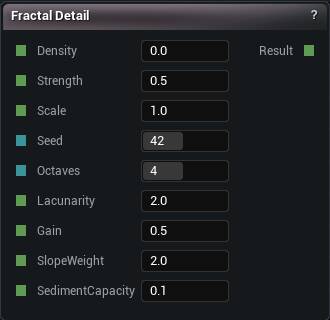
The Erosion node
Slope-weighted fractal noise laid over a shape you already have. Rough highlights along cliffs and ridges, flat ground left mostly alone.
No water is involved and no valleys get carved. Hydraulic Erosion is the one that does that, at the cost of a full simulation on every compile. This is cheap enough to leave switched on while you work.
Save it for last. It roughens large forms. It cannot create them.
| Pin | Type | Description |
|---|---|---|
Density |
Number | The shape you want roughed up. |
Strength |
Number | How much of the detail to add. Push it far and the surface breaks into noise instead of looking weathered. |
Scale |
Number | How big the bumps are. |
Seed |
Whole Number | Changes the pattern without changing anything else. |
Octaves |
Whole Number | How many layers of detail to pile on. Each one is finer than the last and costs a little more. |
Lacunarity |
Number | How much finer each layer gets. |
Gain |
Number | How much quieter each layer gets. |
SlopeWeight |
Number | How much the steep parts get over the flats. At 0 the detail lands evenly everywhere. |
SedimentCapacity |
Number | How much settles into the flat bits. |
| Pin | Type | Description |
|---|---|---|
Result |
Number | The same shape, roughed up. |
Available in Mesh Morpher Graph and Mesh Morpher Studio.
Studio and Graph › Voxel › Modification
Actual water erosion. At compile time it pulls a 2D heightmap out of the field above it, runs tens of thousands of simulated droplets down the slopes, and lets them carve valleys and drop sediment....
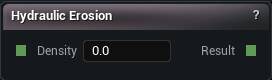
The Hydraulic Erosion node
Actual water erosion. At compile time it pulls a 2D heightmap out of the field above it, runs tens of thousands of simulated droplets down the slopes, and lets them carve valleys and drop sediment. At runtime the eroded heights get sampled back into the density.
| Pin | Type | Description |
|---|---|---|
Density |
Number | The landscape to run water over. It has to be height-based, something like noise minus Position Z. |
| Pin | Type | Description |
|---|---|---|
Result |
Number | The same landscape with valleys cut into it and sediment left in the low spots. |
| Setting | Type | Description |
|---|---|---|
Resolution |
Whole number | How fine the grid the water runs on is. Higher picks up narrower valleys, and costs you compile time and memory for it. |
World Size |
Number | How much ground the simulation covers, in world units, square. Make it smaller than the area you are actually generating and everything past the edge comes out uneroded. |
World Center |
Vector 2D | Where that square sits in the world. |
Blend Margin |
Number | How far past the edge the eroded ground fades back into the ground you fed in. Set it to 0 and the two meet in a step, which the mesher renders as a tall vertical wall right around the perimeter. The default is a tenth of World Size; widen it if the join still shows. |
Num Droplets |
Whole number | How many droplets get released. Too few and you get scattered scratches instead of a connected drainage pattern. More of them means a longer compile. |
Max Droplet Lifetime |
Whole number | How far one droplet is allowed to travel before it gives up. Raise it for long rivers, lower it for short gullies near the peaks. |
Erosion Radius |
Whole number | How wide a track each droplet cuts, in grid cells. Wider gives you smooth valleys, narrow gives you sharp channels. |
Seed |
Whole number | Changes where the droplets start. Same seed, same rivers, every time. |
Inertia |
Number | How much a droplet keeps its heading instead of turning downhill. At 0 it hugs the steepest line and rivers come out kinked; near 1 it coasts straight across dips and barely carves anything. |
Sediment Capacity Factor |
Number | How much a fast droplet can carry. Raise it for deeper carving. |
Min Sediment Capacity |
Number | The floor on that capacity, so a droplet crawling across a flat does not dump everything it is holding in one spot. |
Erode Speed |
Number | How quickly ground is cut away when a droplet has room for more. |
Deposit Speed |
Number | How quickly a droplet lets go of what it is carrying once it is overloaded. |
Evaporate Speed |
Number | How fast a droplet dries up. Higher gives you short streams near the peaks; lower lets them run all the way to the bottom. |
Gravity |
Number | How hard the slope pulls. It sets how much speed a droplet picks up on the way down. |
Initial Water Volume |
Number | How much water each droplet starts with. |
Initial Speed |
Number | How fast each droplet is already moving when it lands. |
Available in Mesh Morpher Graph and Mesh Morpher Studio.