Apply Deltas: Copies a shape change from one mesh onto another, even when the two meshes are built differently.
Apply Deltas (Topo Match): Adds a stored set of vertex movements straight onto a mesh that has the same vertices in the same order.
Get Deltas: Measures how far every vertex moved between two versions of the same mesh.
Transfer Pose: Makes one character take another's pose from point and curve landmarks. Splines are limbs; points are joints. Rotation only - the source keeps its own lengths.
Studio and Graph › Deltas
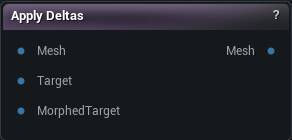
Apply Deltas
You sculpted a change into one mesh and want that same change on a second mesh built from different geometry. Feed the second mesh into Mesh, the unsculpted reference into Target, and the sculpted ...
The Apply Deltas node
When to use it
You sculpted a change into one mesh and want that same change on a second mesh built from different geometry. Feed the second mesh into Mesh, the unsculpted reference into Target, and the sculpted one into Morphed Target.
Pins
Pin
Type
Description
Mesh
Mesh
The mesh you want the change to land on.
Target
Mesh
The reference mesh before it was sculpted.
MorphedTarget
Mesh
The same reference mesh after sculpting. Whatever moved between these two is what gets copied.
Pin
Type
Description
Mesh
Mesh
The input mesh with the change applied.
Settings
Setting
Type
Description
Vertex Threshold
Number
How far the node will look for a matching point on the other mesh. Too low and patches of surface never move at all; too high and the change jumps a gap onto the wrong side of a fold, so lips pull into teeth.
Normal Incompatibility Threshold
Number
How far a surface can face away from a vertex and still count as a match. 0.5 allows anything up to 90 degrees apart; lower is stricter, and 0 skips the check. Lower it when the change keeps landing on the back of a thin part.
Match Material IDs
True/False
Only pair up parts of the two meshes that use the same material. Handy where separate pieces sit close together, like eyeballs inside lids.
Subdivision
Whole number
Splits Target and Morphed Target finer before the change is measured, which gives the transfer more points to hit. Each step roughly quadruples the triangle count, so 1 or 2 is usually as far as you want to go.
Match By UV
True/False
Experimental. Pairs Target and Morphed Target through their UVs instead of vertex order, so those two can have different vertex counts. Skip it on welded meshes - welding is what breaks the UVs this relies on.
Smooth Iterations
Whole number
How many smoothing passes run over the transferred change. Leave it at 0 for a straight transfer; raise it when the result comes out lumpy where the two meshes disagree.
Smooth Strength
Number
How far each smoothing pass moves things. A few gentle passes keep more of the shape than one strong one.
Smooth Type
Choice
Which kind of smoothing to use. Preserve UV Flow weights by triangle shape and holds detail best, Uniform treats every neighbour the same and evens out faster, Delta smooths the movement rather than the surface.
Transfer Bone Transforms
True/False
Also copy bone poses from Morphed Target onto the result, matched by bone name. Bones with no match keep the pose they already had.
Adds a delta set straight onto a mesh, vertex for vertex. When the delta source and the target share vertex count and order, this is the one to use. It is exact, it costs nothing, and there is no c...
The Apply Deltas (Topo Match) node
When to use it
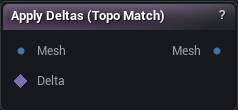
Adds a delta set straight onto a mesh, vertex for vertex. When the delta source and the target share vertex count and order, this is the one to use. It is exact, it costs nothing, and there is no correspondence search to get wrong.
The moment the two differ, index-for-index quietly maps offsets onto unrelated vertices and you get a scrambled mesh instead of an error you can see. Hand it a mesh that has been remeshed or decimated since and the movement lands on whatever vertex happens to hold that number. Apply Deltas exists for that case.
Pins
Pin
Type
Description
Mesh
Mesh
The mesh to move. Same vertices, same order as the mesh the movements came from.
Subtracts a base mesh from a sculpted one and hands you the per-vertex offsets. Apply Deltas (Topo Match) is the other half of the pair: this lifts a shape change off one mesh, that replays it on a...
The Get Deltas node
When to use it
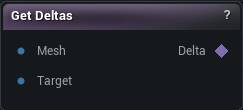
Subtracts a base mesh from a sculpted one and hands you the per-vertex offsets. Apply Deltas (Topo Match) is the other half of the pair: this lifts a shape change off one mesh, that replays it on another.
Wire the untouched mesh into Mesh and the sculpted one into Target. Both inputs need the same vertex count and the same vertex order.
If the result looks like noise rather than a shape, the two meshes went through different remesh or weld steps and no longer index the same vertices. Re-derive both from a common ancestor. Trying to correct the output is wasted time.
Pins
Pin
Type
Description
Mesh
Mesh
The mesh before it was changed.
Target
Mesh
The same mesh after it was changed. Same vertex count, or the node stops with an error.
Makes one character take another's pose from point and curve landmarks. Mesh is the source that gets posed, and its vertex count and layout survive. Target is the character whose pose you are match...
The Transfer Pose node
When to use it
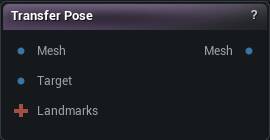
Makes one character take another's pose from point and curve landmarks. Mesh is the source that gets posed, and its vertex count and layout survive. Target is the character whose pose you are matching; different topology is the whole point. Landmarks carry the correspondence: point pairs for joints, spline pairs for limbs, drawn on each mesh as it currently sits.
Pins
Pin
Type
Description
Mesh
Mesh
The mesh that receives the pose. Vertex count and layout survive.
Target
Mesh
The character whose pose to match. Draw matching landmarks on this mesh.
Landmarks
Landmarks
Point pairs (pelvis, head, joints) and spline pairs, where one spline is one limb. Draw matching limbs on both characters.
Pin
Type
Description
Mesh
Mesh
The input mesh, posed. Same vertex count and layout.
Settings
Setting
Type
Description
Transfer Mode
Choice
Rotation Only copies the turn of each limb and keeps this character's own lengths. Polar + Uniform Scale also copies the limb length ratio. Full Affine copies the local linear map and falls back to Polar + Uniform Scale on a collinear neighbourhood.
Handle Strength
Number
How hard the posed handles pull. Higher sticks closer to the transferred pose; lower lets ARAP smooth more.
Arap Iterations
Whole number
How many ARAP stitch passes run. More settles the surface between limbs.
Influence Radius
Number
How far a landmark's pose reaches, in the same units as the mesh. 0 uses 15 percent of the mesh diagonal. Vertices farther than this follow ARAP only, so an undrawn tail stays put.
Height Scale Root
True/False
Currently unused. Pose match is rotation only and does not move the root.