Studio and Graph › AI
Auto-Rig
Predicts a skeleton for a character mesh that arrived without one, using the UniRig model, and writes the bones onto the output mesh: names, parents and bind poses.
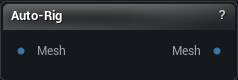
The Auto-Rig node
When to use it
Predicts a skeleton for a character mesh that arrived without one, using the UniRig model, and writes the bones onto the output mesh: names, parents and bind poses.
It emits the skeleton and nothing else. The mesh still has no skin weights when it leaves this node, so it will not deform if you pose it. Auto-Skin is the second half of the pair.
The usual chain is Mesh, Auto-Rig, Auto-Skin: skeleton first, then the weights that bind to it.
Pins
| Pin | Type | Description |
|---|---|---|
Mesh |
Mesh | The character mesh you want a skeleton for. |
| Pin | Type | Description |
|---|---|---|
Mesh |
Mesh | The same mesh, now carrying the predicted bones. No skin weights yet. |
Settings
| Setting | Type | Description |
|---|---|---|
Backend |
Choice | Where the model runs. DirectML uses your GPU and is far quicker; it drops back to the CPU on its own when the GPU cannot take it. |
Seed |
Whole number | The number behind every random choice in the prediction. Same number, same skeleton. Change it and you get a different one to compare against. |
Sample |
True/False | Let the model wander instead of always taking its safest guess. Off gives you the same tidy, symmetric skeleton every time. On finds extra joints now and then, and also gives you a stray bone in one arm that has no twin in the other. Re-roll with Seed if that happens. |
Temperature |
Number | How far the model is allowed to wander when placing joints. Higher is more adventurous and less predictable. |
Top K |
Whole number | Only consider this many of the model's best guesses at each step. 0 lets it consider all of them. |
Top P |
Number | Cuts off the long tail of unlikely guesses. Lower keeps the choice tighter and the skeleton closer to the safe answer. |
Repetition Penalty |
Number | Discourages the model from reusing joint positions it has already placed. 1 leaves it alone. |
Candidates |
Whole number | Predict the skeleton this many times and keep the one with the most joints, which in practice is the one where eyes and finger tips survived. Each extra attempt costs another full run. 1 is the quick pass. |
Available in Mesh Morpher Graph and Mesh Morpher Studio.